

Choice words
Global politics, but #makeitshitty

How we doing out there? Drinking enough water? Getting a little exercise? Calling our friends? Weeks like these are why they came up with the term “self-care”, but they’re also good weeks to crank up the caring-for-others. You might consider taking a cue from our guest Nori Spauwen and making tea for your girlfriend. But then let’s get to it. There’s a lot to discuss.
Who had a good week? Who had a bad week?
Over on the podcast, it was a Good Week for the campaigners of My Voice, My Choice, whose work has made it easier for European women to procure abortions across borders. We’re very into the My Voice, My Choice IG feed in general, but this post is a particularly moreish flavour of goofy celebration:

It was a Bad Week for former Greek finance minister-turned-public intellectual Yanis Varoufakis, who is in hot water for taking an ecstasy pill at a Kylie Minogue concert 36 years ago. And honestly, you don’t have to be a Yanis fanboy/girl to wonder if, in the grand scheme of Holding Men Accountable For Stuff That Went Down A While Ago, this should maybe be low on the priority list?
By the way, how much longer until spring?
13 days, thanks for asking.
Are you a do-gooder type? You’d be surprised how helpful even a small donation to The Europeans can be. Pitch in immediately commence the back-patting!
The cutting-room floor
Last week, we asked you to write in with the names of European leaders who were working to address the real concerns of normal Europeans. (Our inbox and comments section👇 are still open!) This week, many of us normies were rattled by the US and Israel’s attack on Iran – and dismayed by our leaders’ muted and disunified response to it.
Here’s a helpful country-by-country roundup from Politico cataloguing European leaders’ responses to the initial bombing of Tehran. The performance of political softshoe also created a viral moment for the European External Action Service this week, eliciting numerous variations on the theme This is a meme, right?:
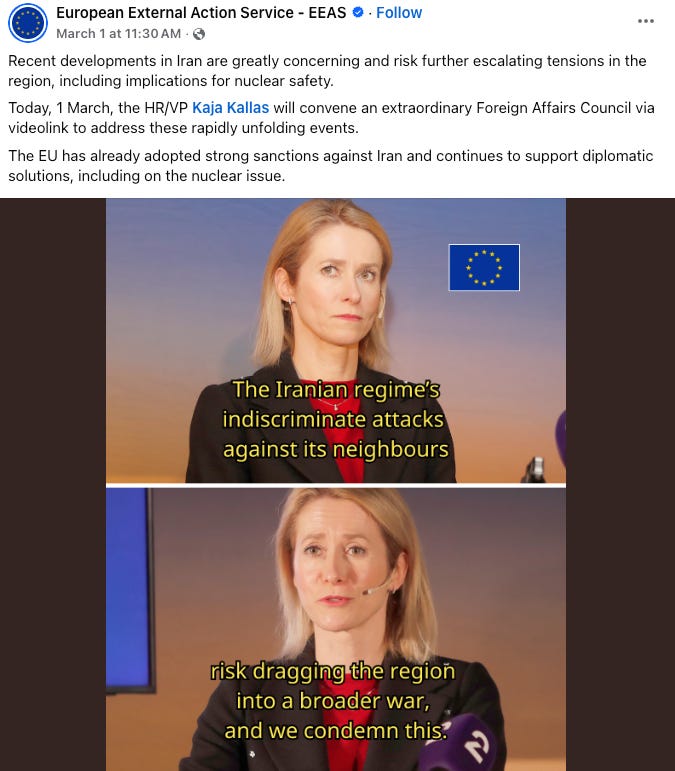
But the political tightwire act has real consequences right here in Europe, and not just because Cyprus, which currently holds the Council of the EU presidency and was targeted in an Iranian drone strike on Monday, is now receiving protection from several other EU countries as the conflict escalates. In Ukraine, the impact of a growing war in the Middle East has had immediate and serious ramifications, as Kallas herself said yesterday. And as Spanish Prime Minister Pedro Sánchez has suggested, the language EU leaders use surrounding the US and Israel’s illegal war contradicts the “values that we defend when we talk about Ukraine, Gaza, Venezuela, or Greenland”, opening the door to future violations of international law.
Ukraine was quick to throw its support behind the US and Israel after the war began last Saturday, citing Iran’s provision of drones to Russia; it was also almost certainly a careful political calculus for Kyiv. Earlier this week, Volodymyr Zelenskyy said that he recognised that there was “a risk” that the war in the Middle East could distract Ukraine’s allies from the war in Europe, but he added, “I hope the Iranian crisis remains a limited operation and doesn’t turn into a long war”.
The same drones that Russia has used to attack Ukraine over the past four years are now striking Washington’s allies, positioning Ukraine as defence experts. On Wednesday, Zelenskyy wrote on X that Ukraine’s allies had reached out for help and that “Ukraine can contribute to protecting lives and stabilizing the situation”. The following evening, in an address to the Ukrainian people, Zelenskyy hedged that generosity: “Of course, any assistance we provide is only on the condition that it does not weaken our own defense in Ukraine and that it serves as an investment in our diplomatic capabilities: we help protect against war those who help us – Ukraine – bring the war to a dignified conclusion.”
Will Ukraine’s partners hold up their end of that bargain? The US and its allies have spent the better part of this week firing defensive missiles that would otherwise have been sent to Eastern Europe. And because the crisis has cut access to much of the oil and gas supply from the Middle East, Russia could profit from the sale of its natural resources to places like China and India even more than it does already, bolstering Russia’s “war chest” with each passing day. And the Kremlin is poised to make the most of this very bad situation by suggesting that Russia might cut off its remaining gas exports to Europe, at a time when energy prices – as you are likely all too well aware – are skyrocketing.
As ghastly as the current situation is, this war is still, for its aggressors, a war of choice – and a choice that was taken without Europe at the table. That makes the language with which Europe has responded to those aggressors all the more unsettling, and it surely does nothing to improve the image of a Europe so weak that it borders on “civilisational erasure”. “If we want international law, rule-based order and any form of multilateralism to prevail, we must be able to express worry about the American actions,” a European diplomat who, naturally, chose to remain anonymous told Politico this week. “What will our leverage be for Putin’s war in Ukraine if Europe cannot express any objections over the U.S. war on Iran?” It’s a very good question.
And now for some other, really (actually) good things from Europe
Abortopedia | ‘I’d like to keep the reproductive-justice momentum going and recommend Abortopedia, a resource that bills itself as “the Wikipedia for abortion access in Europe”. According to Mara Clarke, co-founder of Supporting Abortions for Everyone or S.A.F.E., the platform aims to create a network of abortion resources for people in Europe, akin to existing initiatives in the United States. I also enjoyed this piece from Lazy Women about how the successful My Voice, My Choice European Citizens’ Initiative was born – and learned that apparently some European doctors are practicing abortions on papayas? Wild.’ – Morgan
A Day in the Life of an Ensh*ttificator | ‘I’m absolutely obsessed with a campaign video put out by the Norwegian Consumer Council last week called “A Day in the Life of an Ensh*ttificator”. It’s a masterclass in how to roast the tech industry while making you laugh, cringe, and nod along in recognition of what is being outlined. The satire is making a really serious point: that shitty tech is making our lives worse. The video is a tongue-in-cheek promo for the Consumer Council’s new report, proving that sh*tty tech isn’t inevitable - it’s a choice. And we, the users, don’t have to take it lying down. #makeitshitty’ – Dominic
I regret to report you are not making this newsletter shitty enough. Please try harder.